Showing posts with label Israel. Show all posts

Wednesday, November 19, 2014

The God Who Acknowledged You


Oh, wondrous grace of God, that he owns* his son when that son is still an Egyptian slave. Moreover, God owned his people when they did not own him, for his name “Jehovah” was scarcely known to them. Although Moses presented himself to them with evident credentials, they were ready enough to reject him. They had gone aside unto false gods, we are informed in other parts of the Scripture. During their sojourn in Egypt the Israelites fell into the prevailing superstition of the country, and they forsook the Lord. Some little light still lingered among them. Some traditions were treasured and transmitted from sire to son in solemn trust. Doubtless there was a remnant of pious souls, faithful to the God of Abraham. The bones of Joseph, preserved in Goshen as a memorial of the oath that he took of their tribes, subsequently carried through all their devious wanderings in the wilderness, and ultimately buried in Shechem, as you read in the last chapter of the book of Joshua, vouch for a fidelity we cannot wantonly forget.

But the bulk of the people had fallen into the snares which surrounded them, and conformed to the fashions of those among whom their fortunes were cast, whose gods many and lords many were superstitiously served in secret. They were not a people who could have scraped together so much as a molehill of merit, if they had tried. They were a vain and vicious people, prone to supplant, yet utterly supplanted; specially sinful, because their marked proclivities which might have developed on the side of virtue were perverted into stains and stigmas on their reputation.

Yet Jehovah says, “Israel is my son, even my firstborn.”

* "Owns" in the old sense of acknowledging someone or admitting to something - Ed.

From a sermon by Charles Haddon Spurgeon entitled "The Great Emancipator." Image by Kamil PorembiƄski on Flickr under Creative Commons License, without alteration.

Monday, October 27, 2014

Use The Weapon Of Love


The name of Paul brought the blood into the face of a Jew. He spat in rage. More than forty of them had bound themselves with an oath that they would slay him, and the whole company of the circumcised seemed, wherever he went, to be moved by the same impulse. He frequently gathered large congregations of Gentiles who attended to him earnestly, but the Jews stirred up riots and mobs, and, frequently, he was in danger of his life from them. They detested him; regarding him as an accursed apostate from the faith of his fathers. Remembering how earnest he had been against Christ, they could not believe in his sincerity when he became a Christian, or, if they did, they hated him as a fanatic whose delusion was beyond measure mischievous. His generous retaliation was to pray for them, nay, more, to carry the whole nation on his heart as a burden. “I have continual heaviness,” says he, “and sorrow of heart for my kinsmen according to the flesh.”

Now, if any of you in following Christ should meet with opposition, avenge it in the same way. Love most the man who treats you worst. If any man would kill you in his anger, kill him with your loving prayers. If he smite thee on the one cheek, turn to him the other also in submission, and lift both hands and eyes to heaven and cry, “Father forgive them, for they know not what they do.”

Never let oppressors see your anger rise. They will observe your emotion and your grief, and they will perceive that you are naturally vexed and troubled, but let them also see that you bear them no malice, but desire their welfare. I commend this to those who have a hard fight for Christ in the workroom, in the midst of sneers and jests. Never use the devil’s weapons, though they lie very handy, and look very suitable. Only use Christ's omnipotent weapon of love, so shall ye be his disciples.

From a sermon by Charles Haddon Spurgeon entitled "Concern For Other Men's Souls." Image by maf04 on Flickr under Creative Commons License, without alteration.

Thursday, October 2, 2014

A Christian Must Have A Generous Soul


If a man entered into forced servitude, or came under any bonds to his fellow man among the Jews, he could only be so held for six years, and on the seventh he was to go free. “And when thou sendest him out free from thee, thou shalt not let him go away empty: thou shalt furnish him liberally out of thy flock, and out of thy floor, and out of thy winepress: of that wherewith the Lord thy God hath blessed thee thou shalt give unto him. And thou shalt remember that thou wast a bondman in the land of Egypt, and the Lord thy God redeemed thee.”

The Lord’s people should be considerate of those who are in their employment. The recollection of their own bondage should make them tender and kind to those who are in subservience to themselves, and never should a Christian man be ungenerous, illiberal, severe, churlish with his servants, or with any who are dependent upon him.

Be large-hearted. Do not be angry at every little fault, nor swift to observe every slight mistake; and be not for ever standing on your exact rights, litigious, sticking out for the last half-farthing, as some do. I am almost sorry if a mean, stingy man gets converted, for I am afraid he will be no credit to Christianity. There should be in a man redeemed with the blood of Christ something like nobility of soul and benevolence to his fellow men, and so even this stern book of the law teaches us.

From a sermon by Charles Haddon Spurgeon entitled "Remember," delivered March 31, 1878. Image by Ryan McKee on Flickr under Creative Commons License.

Saturday, September 27, 2014

Come Apart And Rest A While


Repose is as needful to the mind as sleep to the body. Our Sabbaths are our days of toil, and if we do not rest upon some other day we shall break down. Even the earth must lie fallow and have her Sabbaths, and so must we. Hence the wisdom and compassion of our Lord, when he said to his disciples, "Let us go into the desert and rest a while."

What! when the people are fainting? When the multitudes are like sheep upon the mountains without a shepherd? Does Jesus talk of rest? When Scribes and Pharisees, like grievous wolves, are rending the flock, does he take his followers on an excursion into a quiet resting place?

Does some red-hot zealot denounce such atrocious forgetfulness of present and pressing demands? Let him rave in his folly. The Master knows better than to exhaust his servants and quench the light of Israel. Rest time is not waste time. It is economy to gather fresh strength.

From "Lectures To My Students," by Charles Haddon Spurgeon. Image by Nicholas A. Tonelli on Flickr under Creative Commons License.

Monday, March 11, 2013

We Shall Rejoice Together In Him


Looking to him whom they pierced, the whole house of Israel will weep bitterly. And now, dear brethren, it will tend to increase the blessed sorrows which will then sweep over Israel, to think how the Lord has had patience with them, and still has never cast them away. To this day they are as distinct a people as ever they were. They dwell alone; they are not numbered among the people. Persecuted almost beyond conception, poor Israel, for many a century, has been the butt and jest of those - I shame to say it - who called themselves Christians, and yet despised the chosen people of the Lord. Alas! the precious sons of Zion, comparable to fine gold, have been esteemed as earthen pitchers, the work of the hands of the potter! “How hath the Lord covered the daughter of Zion with a cloud in his anger, and cast down from heaven unto the earth the beauty of Israel!” They have for centuries endured a terrible chastening; they have been turned upside down, and wiped as when a man wipeth a dish, but still they stand waiting for a vainly expected King. They would not have their true King, Jesus the Son of David, and they have no other - where is there any king of the Jews? The scepter hath departed from Jacob, and the lawgiver from between his feet, for Shiloh has come, even he who, as he did hang upon the cross, was thrice named, “King of the Jews.”

Jesus is the sole and only King of the Jews, and they are preserved and kept alive notwithstanding a thousand influences which threatened to make them lose their nationality; they shall yet be gathered again, and their restoration shall be the fullness of the Gentiles, and we and they shall rejoice together in him who hath made both one, and broken down the middle wall or partition, so that there is now neither Jew nor Gentile, barbarous Scythian, bond nor free, but we are all one in Christ Jesus.

From a sermon by Charles Haddon Spurgeon entitled "Mourning For Christ," delivered July 1, 1877. Image by Zach Dischner on Flickr under Creative Commons License.

Tuesday, July 3, 2012

Ascribe The Victory To God


The Syrians had been defeated by the Israelites whom they despised. This victory had been achieved by so small a number of men over so vast a host that the Syrians were driven to the conclusion that there was something supernatural about it, and they ascribed their defeat to the God of Israel. They were right in doing so. Brethren, let not these heathen shame us. They knew to whom the crown of the victory belonged, and, little as they understood Jehovah, yet they recognized that his right hand and his holy arm had gotten for his people the victory.

Now, if the Lord has prospered you, if in your souls peace and joy are reigning, or if you have enjoyed success in Christian service, take heed that you do not lift up your horn on high and take honor to yourselves. Render all the glory to God, to whom it is most justly due. Let that psalm, “Not unto us, not unto us, but unto thy name give glory,” be always on your heart, and often on your tongue. The tendency of the human heart towards pride is very strong, and Satan, the great usurper, is always eager to stir us up to rob God of his glory. Yet nothing is more fatal to peace, nothing more sure to provoke God, nothing more certain to bring upon us times of disaster and distress. “The Lord thy God is a jealous God,” and he is jealous of this thing, amongst others, that he will not give his glory to another. He will not allow those whom he uses for his purposes to ascribe their victories unto themselves; the Lord alone must be exalted. Whatever has been done by us, the great Worker who used us must have the praise. We have been nothing more than the axe in the hand of God if we have felled the cedar, nothing more than the net if we have brought the fish to shore. Unto him therefore be praise for ever. So far let us learn from the heathen Syrians.

From a sermon by Charles Haddon Spurgeon entitled "God of the Hills and God of the Valleys," delivered August 27, 1876. Image by Vinoth Chandar on Flickr under Creative Commons License.

Monday, October 24, 2011

We are coming to a jubilee


It was a glad day for Israel when the trumpets rang out the morning of the Jubilee, for every slave was free, and every debtor found his liabilities discharged. Back came each man’s lost inheritance, and the whole nation was glad. With sound of trumpet and of cornet they saluted the rising of the sun on the first day of that Jubilee year; but the jubilee year went by, and lands were mortgaged and forfeited, and slaves fell again into slavery, and bankrupts were again seized by their creditors. Ah, beloved, we are coming to a jubilee, of which the trumpets shall sound on for ever. We shall regain our once forfeited inheritance never to have it encumbered any more; we shall snap the fetters which have bound us, never to feel them again. “If the Son make you free, ye shall be free indeed.”

From a sermon by Charles Haddon Spurgeon entitled "The Eternal Day," delivered May 31, 1874. Image by Luis Argerich on Flickr under Creative Commons License.

Friday, September 30, 2011

He neither slumbers nor sleeps

“Behold, he that keepeth Israel shall neither slumber nor sleep.” 

....What a glorious title is in the Hebrew - “The keeper of Israel,” and how delightful to think that no form of unconsciousness ever steals over him, neither the deep slumber nor the lighter sleep. He will never suffer the house to be broken up by the silent thief; he is ever on the watch, and speedily perceives every intruder. This is a subject of wonder, a theme for attentive consideration, therefore the word “Behold” is set up as a waymark. Israel fell asleep, but his God was awake. Jacob had neither walls, nor curtains, nor body - guard around him; but the Lord was in that place though Jacob knew it not, and therefore the defenceless man was safe as in a castle.

From The Treasury of David, Charles Haddon Spurgeon, exposition of Psalm 121:4. Image by Bert Kaufmann on Flickr under Creative Commons License.

Monday, April 11, 2011

A future and a hope for Israel


They are scattered: behold them wandering on the face of the earth without a country of their own; they are a people who have been oppressed and downtrodden almost beyond belief: the hand of the heathen and the hand of the so-called Christian hath been very heavy upon them; they have been jeered and hooted at for ages, though they are in truth the very nobles of God, and their ancient lineage is like that of kings. Let us not, however, despair for them. Abraham, their father, was but a heathen when God called him out of a family that had worshipped the seraphs and made him to be a witness of the living and true God, and honored his faith with exceeding great reward.

Doubt not, then, that he can call Israel again from all her wanderings, cleanse her from all her profane traditions and her unbelief, and separate her unto himself to be a holy people, in whom once again his power shall be made known, and made known in such a way that they shall not speak of the ark of the Lord, or the redemption out of Egypt as the chief symbol of their national glory, or the grandest theme of their patriotic song, for a greater redemption and a greater manifestation of the Divine presence shall be in the midst of Israel than the wilderness of Sinai had ever known, or the mountains round about Jerusalem had ever witnessed. God grant it to them, and hasten the fulfillment of the promises in which he has made us to hope.

From a sermon by Charles Haddon Spurgeon entitled "A Bright Light in Deep Shades," delivered May 12, 1872. Image by nao.k under Creative Commons License.

Thursday, November 4, 2010

The Deliverer Shall Come out of Zion


“In that day there shall be a fountain opened to the house of David and to the inhabitants of Jerusalem for sin and for uncleanness.” — Zechariah 13:1.

We do not grudge to the seed of Israel after the flesh the first application of this very precious promise. There will be a day when those who have so long refused to acknowledge Jesus as the Messias shall discern the marks of his mission, and shall mourn that they have pierced him. When the tribes of Israel shall lament their sin with holy earnestness, there shall be no mourning to exceed it, they shall weep even as in the mourning of Hadadrimmon in the valley of Megiddo, when the wellbeloved Josiah was slain. Discovering that their nation rejected the Son of God, when they crucified Jesus of Nazareth their deeply religious spirit shall be filled with the utmost bitterness of repentance, and each man and each woman shall cry for pardon to the Lord of mercy.

Then, close upon the heels of the weeping shall come the full and complete forgiveness; the transgression of the tribes shall be put away in one day; they shall perceive that the very side which they pierced has yielded a fountain to cleanse them from their sin; joyfully shall they behold on Calvary the brazen serpent lifted up for their healing, the Paschal Lamb slain for their redemption, the sin-offering sacrificed in their stead. What a blessed day will that be when “all Israel shall be saved" as it is written, "There shall come out of Zion the Deliverer, and shall turn away ungodliness from Jacob.”

O that you and I might live to see that happy era when all the Jewish race shall behold their Messias; for then shall the fullness of the Gentiles be gathered in. Our history is wrapped up with theirs. “Through their fall salvation is come unto the Gentiles. Now if the fall of them be the riches of the world, and the diminishing of them the riches of the Gentiles; how much more their fullness?”

From a sermon by Charles Haddon Spurgeon entitled "The Open Fountain," delivered January 22, 1871. Image by Ron Almog under Creative Commons License.

Monday, July 5, 2010

God has not cast away His ancient people

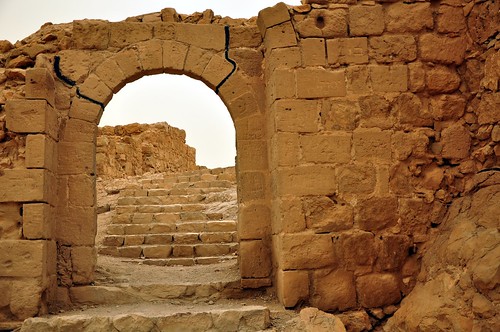
Gate at the fortress of Masada in Israel
Gate on top of the fortress of Masada

They were favored with special protections in providence, with special guidances in all their difficulties, special supplies in time of famine; and if they sometimes had special chastisements, yet even these were but tokens of his peculiar regard. Israel was precious in the sight of God, and therefore, though small and inconsiderable, it was honorable among the nations, so that David could truthfully say, “What one nation in the earth is like thy people, even like Israel, whom God went to redeem for a people to himself?”

I need not dwell upon God’s special love to Israel. We believe it continues to this hour, and though the scattered nation be despised, and the precious sons of Zion comparable to fine gold are esteemed as earthen pitchers, the work of the hands of the potter, yet the day shall come when “There shall come out of Sion the Deliverer, and shall turn away ungodliness from Jacob.” Then Judea’s mountains (thy land, O Immanuel), shall drop down with new wine, and the hills shall flow with milk; then the glorious diadem of her former glory shall return to Zion’s brow, and God, even her own God, shall bless her. The covenant of salt shall be remembered, and it shall be seen that the Lord hath not cast away his people whom he did foreknow.

From a sermon entitled "Precious, Honorable, Beloved," delivered February 20, 1870. Image by Matt Mickelson under Creative Commons License.

Monday, April 13, 2009

That blessed hope


They will wait in vain now for his first coming, that having passed already. Waiting for the Messiah was a virtue in Simeon’s day: it is the infidelity of the Jews now, since the Messiah is come. Still there is a high sense in which the Christian ought to be every day waiting for the consolation of Israel. I am very pleased to see that the doctrine of the second advent of Christ is gaining ground everywhere. I find that the most spiritual men in every place are “looking for,” as well as “hastening unto,” the coming of our Lord and Savior. I marvel that the belief is not universal, for it is so perfectly scriptural. We are, we trust, some of us, in the same posture as Simeon. We have climbed the staircase of the Christian virtue, from whence we look for that blessed hope, the coming of our Lord Jesus Christ.

From a sermon entitled "Simeon." Image by Roberto Ferrari under Creative Commons License.

Wednesday, February 18, 2009

Jehovah-Nissi


Go to him, whatever may be the trouble which weighs you down. Do not suppose your case too bad, for nothing is too hard for the Lord, and dream not that he will refuse to undertake temporals as well as spirituals; he careth for you in all things. In everything you are to give thanks, and surely in everything by prayer and supplication, you may make known your wants unto God. In times when the cruse of oil is ready to fail, and the handful of meal is all but spent, then go to the all-sufficient God, and you shall find that they who trust in him shall not lack any good thing.

Furthermore, our God is the refuge of his saints when their enemies rage. When the host was passing through the wilderness they were suddenly attacked by the Amalekites. Unprovoked, these marauders of the desert set upon them, and smote the hindermost of them, but what did Israel do? The people did not ask to have a strong body of horsemen, hired out of the land of Egypt for their refuge, or even if they did wish it, he who was their wiser self, Moses, looked to another arm than that of man, for he cried unto God. How glorious is that picture of Moses, with uplifted hands, upon the top of the hill giving victory to Joshua in the plain below. Those uplifted arms were worth ten thousand men to the hosts of Israel; nay, twice ten thousand had not so easily gotten a victory, as did those two extended arms, which brought down Omnipotence itself from heaven. This was Israel’s master-weapon of war, their confidence in God. Joshua shall go forth with men of war, but the Lord, Jehovah-nissi, is the banner of the fight, and the giver of the victory. Thus, dear friends, the Eternal God is our refuge. When our foes rage, we need not fear their fury. Let us not seek to be without enemies, but let us take our case and spread it before God. We cannot be in such a position, that the weapons of our foes can hurt us, while the promise stands good: “No weapon that is formed against thee shall prosper, and every tongue that riseth against thee in judgment thou shalt condemn.” Though earth and hell should unite in malice, the Eternal God is our castle and stronghold, securing to us an everlasting refuge.

From a sermon entitled "Present Privilege And Future Favor," delivered March 22, 1865. Image by Nattu under Creative Commons License.

Tuesday, January 20, 2009

God hath not cast away his people


If our view of prophecy be the correct one, it seems to be in perfect harmony with all the doctrines of the gospel. God certainly did elect his people the Jews; he made a covenant with his servant Abraham, and albeit you will remind us that this was only a temporal covenant, I would remind you that it was the type of the spiritual one, and it would be an unhappy reflection for us if the typical covenant should prove to be only temporary as well as temporal; if that came to an end, and if God cast away, in any sense, the people whom he did foreknow, it might augur to us the ill foreboding that mayhap he might cast away his spiritual seed also, and that those who were chosen as the spiritual seed of Abraham, might yet be cut off from the olive into which they had been grafted. If the natural branches are cast away for ever, why not the grafted branches too?

But here is our joy, the God who swore unto his servant Abraham that to him and to his seed would he give the land for ever, hath not gone back from his word; they shall possess the land; their feet shall joyously tread its fruitful acres yet again; they shall sit every man under his own vine and under his own fig tree, and none shall make them afraid; and so the spiritual seed to whom the spiritual heritage is given as by a covenant of salt, they also shall possess their heritage for ever, and of their rightful portion no robber shall despoil them.

From a sermon entitled "The Man With The Measuring Line," delivered December 11, 1864. Image by David King under Creative Commons License.

Thursday, December 4, 2008

Preach Christ, and see dead bones live


But still, the main thing which we have to preach about is Christ. Depend upon it, dear brethren, the best sermons which we ever preach are those which are fullest of Christ. Jesus the Son of David and the Son of God; Jesus the suffering Savior by whose stripes we are healed; Jesus able to save unto the uttermost - here is the most suitable subject for Gentiles, and God has fashioned all hearts alike, and therefore, this is also the noblest theme for Jews. Paul loved his countrymen; he was no simpleton; he knew what was the best weapon with which to assail and overcome their prejudices, and yet he could say, “I determined not to know anything among you save Jesus Christ and him crucified.”

Lift up the Messiah, then, both before Jew and Gentile. Tell of Mary’s Son, the eternal Son of God, the Man of Nazareth, who is none other than the incarnate Word, God made flesh, and dwelling amongst us. Preach his hallowed life - the righteousness of his people; declare his painful death - the putting away of all their sins. Vindicate his glorious resurrection, the justification of his people; tell of his ascent on high, their triumph over the world and sin; declare his second advent, his glorious coming, to make his people glorious in the glory which he hath won for them, and Christ Jesus, as he is thus preached, shall surely be the means of making these bones live.

From a sermon entitled "The Restoration And Conversion Of The Jews," delivered June 16, 1864. Flickr photo by Jason; some rights reserved.

Thursday, November 6, 2008

Not by our own sword


“For they did not get the land in possession by their own sword.”


Behold how the Lord alone was exalted in bringing his people to the land which floweth with milk and honey! He, in his distinguishing grace, had put a difference between Canaan and Israel, and therefore, by his own effectual power, he wrought for his chosen and against their adversaries. The tribes fought for their allotments, but their success was wholly due to the Lord who wrought with them. The warriors of Israel were not inactive, but their valour was secondary to that mysterious, divine working by which Jericho's walls fell down, and the hearts of the heathen failed them for fear. The efforts of all the men-at-arms were employed, but as these would have been futile without divine succour, all the honour is ascribed unto the Lord.

The passage may be viewed as a beautiful parable of the work of salvation; men are not saved without prayer, repentance, etc., but none of these save a man, salvation is altogether of the Lord. Canaan was not conquered without the armies of Israel, but equally true is it that it was not conquered by them; the Lord was the conqueror, and the people were but instruments in his hands.

From The Treasury of David, exposition of Psalm 44:3. Flickr photo by William & Lisa Roberts; some rights reserved.

Wednesday, September 17, 2008

With great mercies


“And it shall come to pass, that as ye were a curse among the heathen, O house of Judah, and house of Israel, so will I save you and ye shall be a blessing: fear not, but let your hands be strong.” — Zechariah 8:13.


As these words came from the lips of Zechariah, doubtless they referred to the seed of Abraham, including the two tribes of Judah and the ten tribes of Israel. They have already received a minor fulfillment; but their most glorious accomplishment is yet to come. The Jews have for many a generation been cursed by all people. For ages no one had a good word or a kind look for the Jew. In every nation they have been persecuted, and hunted like beasts of prey.... In our own country, in the dark ages, it was accounted God’s service to afflict the Israelites, and the day upon which the Church celebrated our Savior’s passion was chosen for the public stoning of his own brethren if they ventured into the streets. To be a Jew was, in the estimation of that era, to be deserving of all scorn and cruelty, and of no pity or consideration.

To what exactions, to what fines, to what imprisonments and tortures, have not the sons of Jacob been subjected by the professed followers of the Messiah? It is perhaps the greatest of all modern miracles, that there should be one Jew upon earth who is a Christian, for the treatment they have received from pretended Christians has been enough to make them hate the name of Jesus; it has been not simply villainous, but diabolical. Devils in hell could not be more cruel to their victims than professed Christians have been to the sons of Abraham. They have been a curse indeed. The whole vocabulary of abuse from “dog” down to “devil” has been exhausted upon them; among all nations they have been a hissing and a byword. But the day is coming, yea it dawns already, when the whole world shall discern the true dignity of the chosen seed, and shall seek their company, because the Lord hath blessed them. In that day when Israel shall look upon him whom they have pierced, and shall mourn for their sins, the Jew shall take his true rank among the nations as an elder brother and a prince.

The covenant made with Abraham, to bless all nations by his seed, is not revoked; heaven and earth shall pass away, but the chosen nation shall not be blotted out from the book of remembrance. The Lord hath not cast away his people; he has never given their mother a bill of divorcement; he has never put them away; in a little wrath he hath hidden his face from them, but with great mercies will he gather them. The natural branches shall again be engrafted into the olive together with the wild olive graftings from among the Gentiles. In the Jew, first and chiefly, shall grace triumph through the King of the Jews. O time, fly thou with rapid wing, and bring the auspicious day!

From a sermon entitled "Once A Curse But Now A Blessing," delivered December 6, 1863. Flickr photo by Ron Almog; some rights reserved.

Friday, August 8, 2008

He shall rejoice over thee with singing

Midsummer Sunset

In the making of worlds, he stands at a distance and speaks his will; but when he creates saints, and redeems his people, he comes out of his chambers — he rends the heavens and comes down, he reveals himself as a God nigh at hand; he standeth over his work as the potter over the clay upon the wheel. It is written, that when he made the heavens and the earth, that “the morning stars sang together, and all the sons of God shouted for joy;” but I never hear that God sang; there is nothing in the merely material universe to stir the Infinite heart; the work is not dear enough to him, nor so full of satisfaction as the grand work of redeeming love; but when he saved his people — when he created Israel for himself, I hear it said — “He shall rest in his love; he shall rejoice over thee with singing.”

From a sermon entitled "A Precious Drop Of Honey," delivered May 31, 1863. Flickr photo by ccgd; some rights reserved.

Thursday, June 26, 2008

Who is like the Lord?

Golden sun

“Who is like unto the Lord our God?”


The challenge will never be answered. None can be compared with him for an instant; Israel's God is without parallel; our own God in covenant stands alone, and none can be likened unto him. Even those whom he has made like himself in some respects are not like him in godhead, for his divine attributes are many of them incommunicable and inimitable. None of the metaphors and figures by which the Lord is set forth in the Scriptures can give us a complete idea of him; his full resemblance is borne by nothing in earth or in heaven. Only in Jesus is the Godhead seen, but he unhesitatingly declared “he that hath seen me hath seen the Father.”

“Who dwelleth on high.”

In the height of his abode none can be like him. His throne, his whole character, his person, his being, everything about him, is lofty, and infinitely majestic, so that none can be likened unto him. His serene mind abides in the most elevated condition, he is never dishonoured, nor does he stoop from the pure holiness and absolute perfection of his character. His saints are said to dwell on high, and in this they are the reflection of his glory; but as for himself, the height of his dwelling-place surpasses thought, and he rises far above the most exalted of his glorified people.

From the Treasury of David, exposition of Psalm 113:5. Flickr photo by law_keven; some rights reserved.

Wednesday, March 12, 2008

Ascribe greatness to our God


We believe that the Father is God, and we ascribe unto him greatness, for we believe that he made the world and settled the pillars thereof; that he fashioned the universe, and that he moves the starry orbs through space. We look up to the wondrous depths of shoreless night, and we see the starry fleet sailing alone, and we believe that God is their captain. We look further still, and as by the aid of science we discover the void illimitable, we believe that God dwells there, and is the infinite Creator and preserver of all things that exist and subsist. We ascribe greatness unto him, the Creator and the Protector of the world.... We solemnly subscribe to the creed of St. Athanasius, that though there are not three Gods, but one God, yet there are three persons in the glorious Trinity in unity of the everlasting Jehovah, unto whom belong the shouts of the universe, the songs of angels, and the ascription of our united praise, Our God, then, is to be understood as Father, Son, Holy Ghost! one God whom we adore, — and the words of Moses apply to the God of Christians as well as to the God of Jews: — “Ascribe ye greatness unto our God.”

From a sermon entitled "The Great Supreme," delivered September 28, 1856. Flickr photo by Brian; some rights reserved.